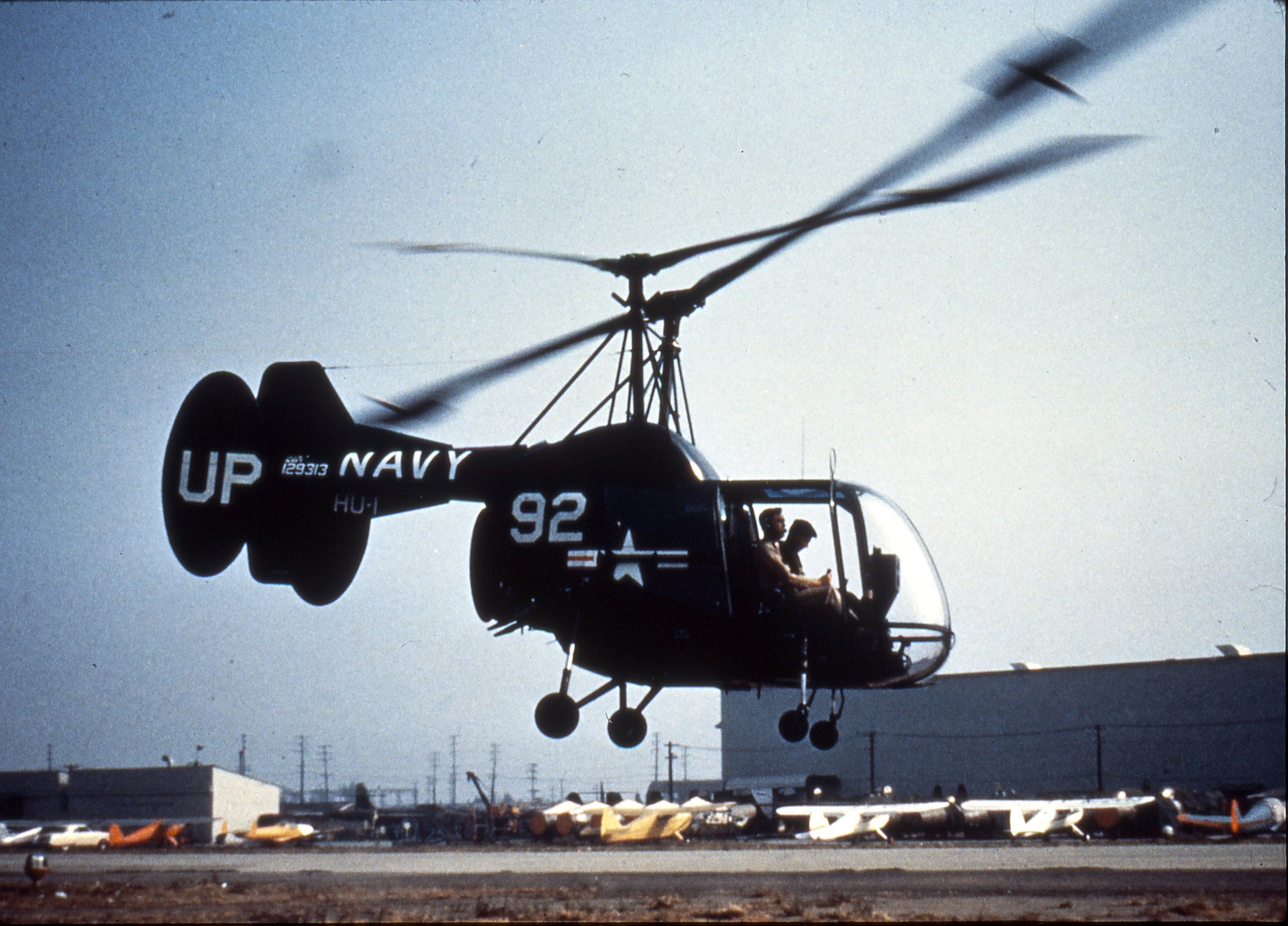
The HTK-1 is one of many Kaman helicopters to incorporate a unique intermeshing rotor technology with servo-flap control. It has counter-rotating main rotors and no tail rotor, which allows all engine power to go directly to the main rotors for the highest lifting efficiency of any rotor configuration. Because of its design, the helicopter’s twin intermeshing rotors made a tail rotor unnecessary. All of the engine power could be devoted to lift and propulsion of the helicopter. If you look closely, you’ll see the rotor shafts are tilted at an angle and the blades are synchronized to permit the operation of both blades at the same time.
The Museum’s Kaman HTK-1 was accepted by the U.S. Navy on April 29, 1953 and served with several Navy squadrons, including with Helicopter Utility Squadron 1, (HU-1) at Ream Field in Imperial Beach, California, and Fasron 4 (Fleet Aircraft Service Squadron) in San Diego, California, before being retired in November 1955. Over the course of its Navy career, the helicopter flew a mere 293 hours before it was placed out of service. The helicopter was acquired by the National Museum of Naval Aviation in Pensacola, Florida and is generously being loaned to the Tillamook Air Museum by them.
SPECIFICATIONS
Type Training Helicopter
Weight 1,800 lbs. empty
Rotor Diameter 38 ft. 0 in.
Length 23 ft. 0 in.
Height 11 ft. 0 in.
Powerplant One 245 hp Lycoming O-4 Opposed Piston Engine
PERFORMANCE
Maximum Speed 105 mph
Cruise Speed 120 mph
Service Ceiling 21,000 ft.